Stitch Types
Running/Triple Stitch
The running stitch is the most basic stitch, stitching after a constant distance. The triple stitch is the same as a running stitch, except each stitch is stitched three times, resulting in a thicker and more secure thread.
 1import turtlethread
 2
 3turtle = turtlethread.Turtle()
 4
 5with turtle.running_stitch(25):
 6    turtle.forward(100)
 7
 8with turtle.triple_stitch(40): # Will look identical, but with different stitch length
 9    turtle.forward(100)
10
11turtle.visualise()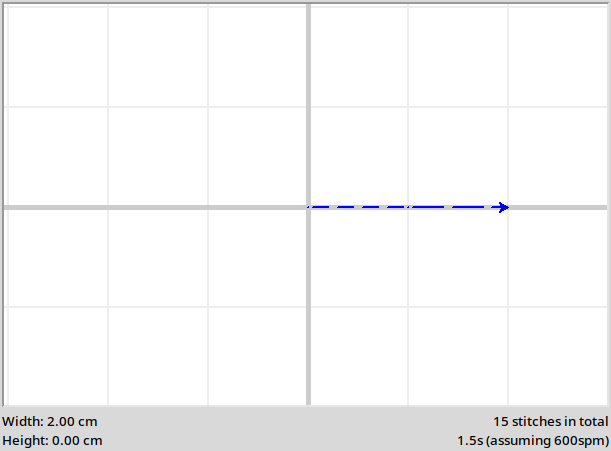
Jump Stitch
The jump stitch will move the needle from one position to another. It is visualised as a grey ‘X’ at the starting point and a grey circle at the ending point.
 1import turtlethread
 2
 3turtle = turtlethread.Turtle()
 4
 5with turtle.running_stitch(25):
 6    turtle.forward(100)
 7
 8with turtle.jump_stitch():
 9    turtle.right(90)
10    turtle.forward(25)
11    turtle.right(90)
12
13with turtle.triple_stitch(40):
14    turtle.forward(100)
15
16turtle.visualise()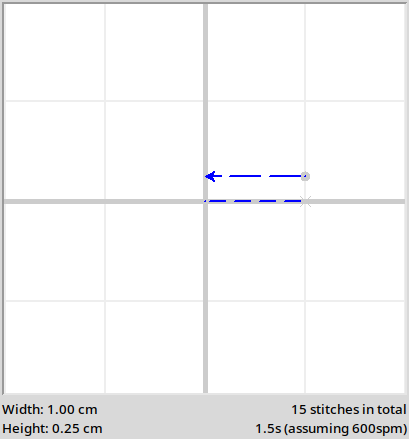
Zigzag Stitch
The zigzag stitch creates a zigzag pattern.
 1import turtlethread
 2
 3turtle = turtlethread.Turtle()
 4
 5with turtle.zigzag_stitch(25, 25): # By default, the zigzag is not centered!
 6    turtle.forward(200)
 7
 8with turtle.jump_stitch():
 9    turtle.goto(0, 50)
10
11with turtle.zigzag_stitch(25, 50, center=True): # Stitch length of 25, stitch width of 50
12    turtle.forward(100)
13
14with turtle.zigzag_stitch(50, 25, center=True): # Stitch length of 50, stitch width of 25
15    turtle.forward(100)
16
17turtle.visualise()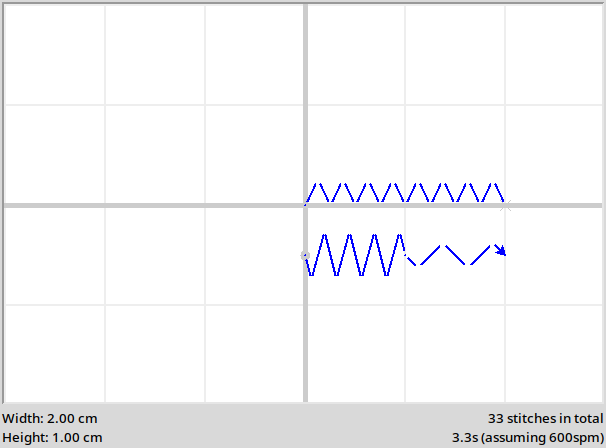
It can be used to add texture to the border of a shape.
Note that a stitch length of less than 3 units is not recommended, as it may cause the embroidery machine to jam.
Satin Stitch
The satin stitch creates a bulky, solid stitch.
1import turtlethread
2
3turtle = turtlethread.Turtle()
4
5with turtle.satin_stitch(25):
6    turtle.forward(100)
7
8turtle.visualise()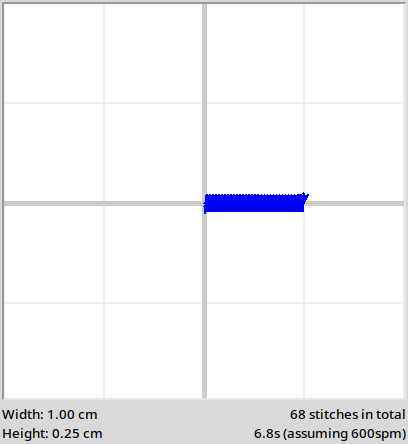
It is used to form defined borders. Internally, it is just a zigzag stitch with a stitch length of
0.3mm(3 units).
Note that satin stitches are very dense, hence they take a long time to be embroidered.
It is also recommended not to overlap satin stitches as it may cause the embroidery machine to jam.
Cross Stitch
The cross stitch leaves a stitch pattern with a cross pattern.
 1import turtlethread
 2
 3turtle = turtlethread.Turtle()
 4
 5with turtle.cross_stitch(25, 25): # By default, the zigzag is not centered!
 6    turtle.forward(200)
 7
 8with turtle.jump_stitch():
 9    turtle.goto(0, 50)
10
11with turtle.cross_stitch(25, 50, center=True): # Stitch length of 25, stitch width of 50
12    turtle.forward(100)
13
14with turtle.cross_stitch(50, 25, center=True): # Stitch length of 50, stitch width of 25
15    turtle.forward(100)
16
17turtle.visualise()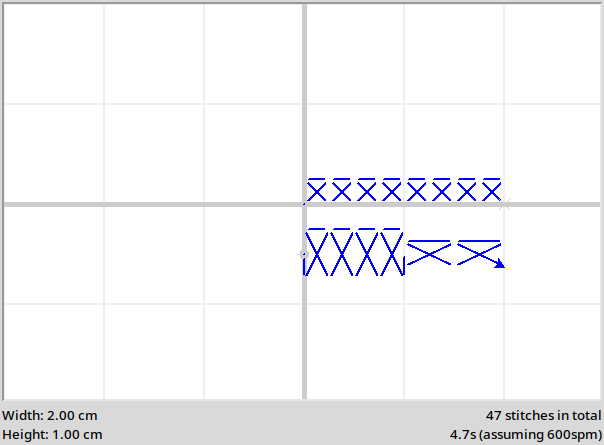
Note that this is not a ‘traditional’ or ‘hand-embroidered’ cross stitch, but a modified variant as embroidery machines are unable to replicate that form of cross stitch.
Z Stitch
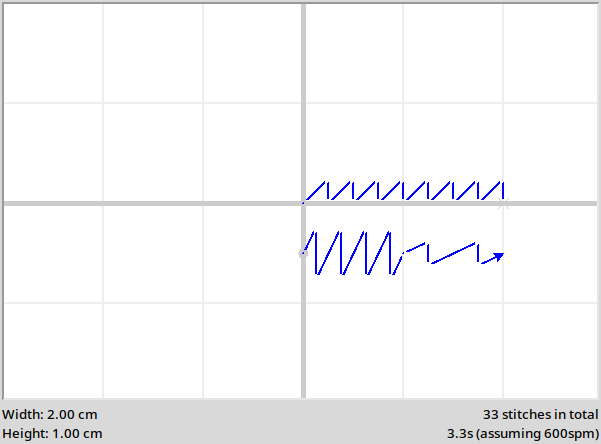
The Z stitch creates a Z-shaped pattern, similar to a zigzag stitch.
 1import turtlethread
 2
 3turtle = turtlethread.Turtle()
 4
 5with turtle.z_stitch(25, 25): # By default, the zigzag is not centered!
 6    turtle.forward(200)
 7
 8with turtle.jump_stitch():
 9    turtle.goto(0, 50)
10
11with turtle.z_stitch(25, 50, center=True): # Stich length of 25, stitch width of 50
12    turtle.forward(100)
13
14with turtle.z_stitch(50, 25, center=True): # Stich length of 50, stitch width of 25
15    turtle.forward(100)
16
17turtle.visualise()